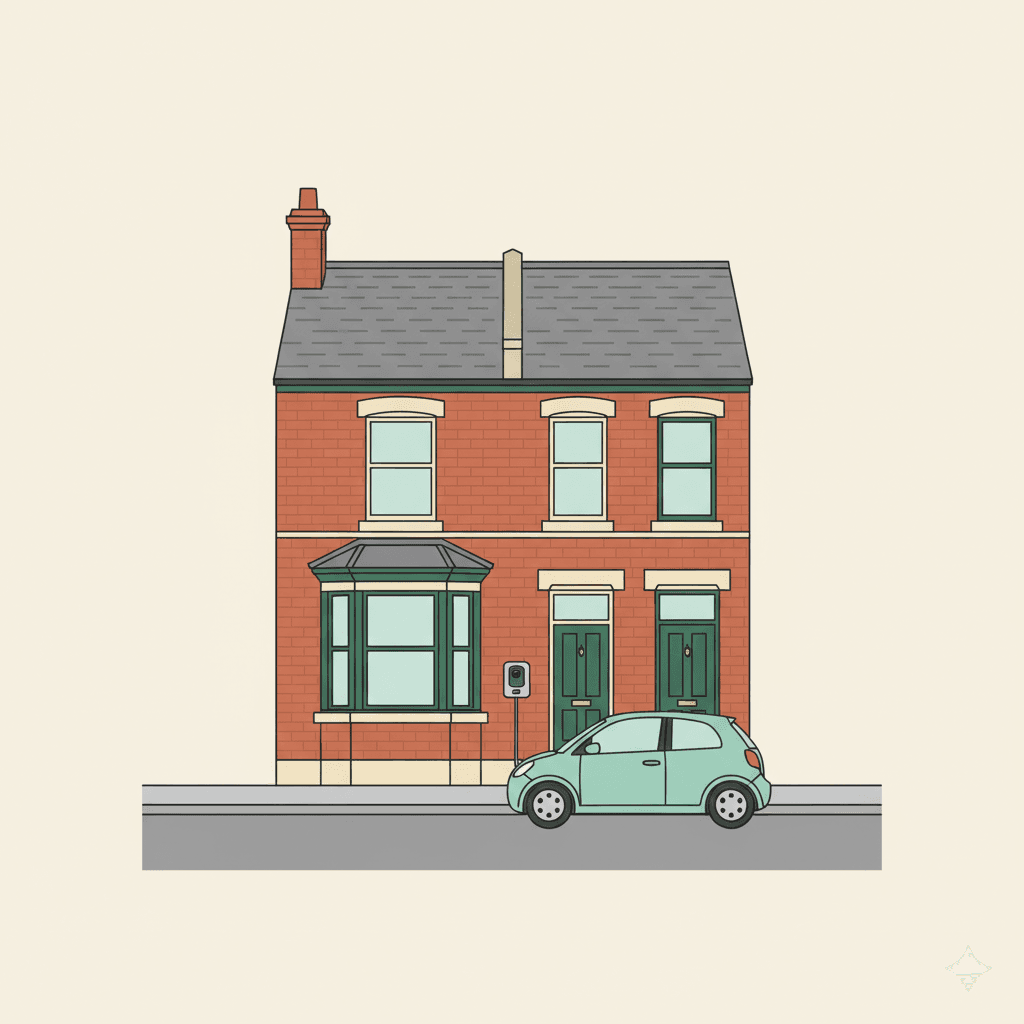
Unlike a modern detached house with a 100A supply and an adjacent driveway, a period terrace often requires a more considered approach to electrical engineering and, sometimes, planning. This guide outlines the four main obstacles — supply capacity, cable routing, planning constraints, and parking — and what each one means for your installation.
1. The electrical supply problem
Most Victorian properties were never designed for the sustained high loads of an EV charger. A standard 7.4kW charger draws approximately 32 Amps continuously. In a property with a 60A main fuse — common in pre-war terraces — this single appliance can account for over half your total available supply.
Supply capacity and the main fuse
A competent installer will begin by checking your cut-out — the main fuse where electricity enters your property from the street. Many Victorian terraces still operate on a 60A supply. Running a 7.4kW charger simultaneously with an electric shower and an oven can push a 60A supply to its limit or beyond.
If your supply is inadequate, your installer must notify your Distribution Network Operator (DNO) — the regional company responsible for the cables and infrastructure that deliver power to your street. In most cases, a fuse upgrade is provided free of charge if the existing street infrastructure can support it. However, if your property has a “looped” supply shared with a neighbour, or the service cable requires replacement, you may face a wait of 6 to 12 weeks and potentially some costs for civil works on your land.
Load management chargers
The modern solution for marginal supplies is a load management charger. Brands such as Myenergi (Zappi), Ohme, and Hypervolt use a Current Transformer (CT) clamp fitted to your main supply cable. If the house's total load approaches the fuse limit, the charger automatically throttles its output — so you never blow the fuse, even if the oven and shower are running simultaneously.
- CT clamp and additional wiring typically adds £50–£100 to the installation cost
- Compatible with all major smart EV tariffs (Octopus Intelligent, OVO Charge Anytime, etc.)
- Strongly recommended for any period property with a 60–80A supply
Consumer unit upgrades
Many period properties still have older consumer units (“fuse boards”) without the Type A RCD protection that modern EV charger installations require. If your board needs upgrading, expect to add £400–£900 to your total cost. This is also an opportunity to future-proof the property for other high-draw technologies such as heat pumps or battery storage.
2. The cable run problem
In a Victorian terrace, the electricity meter is often located at the rear of the property or under the stairs, while the car sits at the front. This means the cable connecting the two can be substantial.
The 25-metre rule and OZEV grant eligibility
OZEV grant criteria assume a standard cable run. If the route from your consumer unit to your parking position exceeds 25 metres, some grant schemes may not cover the full scope of work. Your installer should measure this during their survey — not estimate it from a photograph.
Longer runs also require thicker cable to prevent voltage drop, which increases material costs. As a rough guide, expect to add £15–£20 per extra metre beyond the standard run for surface-mounted armoured cable.
Routing and aesthetics
Running black SWA (Steel Wire Armoured) cable across the front elevation of a red-brick Victorian facade is technically straightforward but visually poor. Experienced installers working in period properties will typically offer alternatives:
- Hiding cable behind existing rainwater downpipes or within external render (where present)
- Routing through the floor void — requires lifting floorboards, adds £300–£500 in labour
- Colour-matched conduit to blend with brickwork or painted surfaces
If your property is in a conservation area or is listed (see below), the routing method may also be subject to planning considerations — another reason a physical site survey is essential before committing to an installer.
3. Listed buildings and conservation areas
England has approximately 400,000 listed buildings, a significant proportion of which are Victorian and Edwardian terraces in historic town centres. There are also thousands of designated conservation areas in which additional restrictions apply.
Permitted development rights
In England, the Town and Country Planning (General Permitted Development) Order generally allows EV charger installation on a dwelling without a formal planning application, subject to conditions (the unit must be under 0.2 cubic metres and not positioned on a wall or roof slope that faces a highway).
These permitted development rights are restricted in certain circumstances:
- Conservation areas: If the installation "materially affects the external appearance of the building," your Local Planning Authority (LPA) may require a full planning application. Updated government guidance (2025) takes a more permissive approach, but many councils retain specific local policies. When in doubt, submit a pre-application enquiry to your LPA — it is usually free and takes 2–4 weeks.
- Listed buildings: You almost certainly require Listed Building Consent (LBC) before installing a charger on or within a listed building. Proceeding without LBC is a criminal offence under the Planning (Listed Buildings and Conservation Areas) Act 1990, regardless of the size of the unit.
Historic England guidance
Historic England's guidance on EV charging in heritage properties recommends positioning charger units in less sensitive areas wherever possible — ideally inside a garage or behind a garden wall rather than on original masonry. For terraced properties without a garage, a pedestal-mounted unit in a small front garden is generally preferred over wall-mounting on original brickwork, as it avoids drilling into historic fabric.
Practical tip for consent applications
When applying for Listed Building Consent or planning permission in a conservation area, propose a unit with a finish that complements your masonry — stone or dark grey are often approved where white plastic is refused. Ensure all cabling shown in the drawings is hidden or colour-matched. A heritage consultant can prepare the application for £250–£500 and significantly improves approval rates.
4. The no-driveway problem
Running a cable across a public pavement to a car parked on the street is a trip hazard and constitutes an obstruction of the highway under the Highways Act 1980. It is not a viable long-term solution, and liability for any trip or injury rests with the householder, not the council.
However, as of 2026, several alternatives are becoming more widely available:
- Cross-pavement channels: some councils now permit a narrow, lockable gully cut into the pavement under a formal licence agreement with the local Highways Authority. Availability varies significantly by area — contact your council to check.
- Dropped kerb and new driveway: the most reliable long-term solution. Requires a Section 184 Highways Act application to your local authority (typical cost: £1,000–£3,000 for the kerb alone, plus driveway construction). Wait times are commonly 3–9 months.
- Lamp column chargers: many councils are installing charge points in street lighting columns. These serve whole streets rather than individual homes, but may be adequate if you can park close to one consistently.
For a full treatment of this topic, see our separate guide on EV charging with no driveway.
5. OZEV grant eligibility for Victorian terraces
Government grant support for domestic EV charging has evolved since the original Electric Vehicle Homecharge Scheme closed to homeowners in April 2022. As of 2026, the position is as follows:
- Homeowners in houses: No longer eligible for the standard domestic grant. The EVHS closed to this group in April 2022.
- Renters and flat owners (including leaseholders): Eligible for £500 (from April 2026) toward a smart charger installation under the EV Chargepoint Grant for Renters and Flat Owners, provided the work is carried out by an OZEV-authorised installer and the vehicle is on the OZEV-approved list.
- On-street parking residents: A £500 (from April 2026) grant is available for eligible residents installing a cross-pavement solution with Highways Authority approval, where an on-street charge point is not available. Check current eligibility at gov.uk — grant conditions can change.
Always verify with the official source
Grant rules change. The current official guidance is at gov.uk/guidance/electric-vehicle-chargepoint-grants. We also maintain an overview on our OZEV grant guide.
6. Choosing the right installer for a period property
Installing a charger on a new-build is a commodity job. Installing one on a 120-year-old terrace is a bespoke engineering project. The difference shows up in survey quality, not just price. When comparing installers, prioritise those who:
- Conduct a physical site survey: Avoid any installer who quotes from photos or a form alone. A Victorian terrace requires eyes on the consumer unit, the earthing arrangement, the cable route, and the parking position before a reliable figure can be given.
- Understand earthing arrangements: Victorian homes commonly have TN-S or TN-C-S earthing. Modern chargers with built-in "open PEN protection" (Ohme, Zappi, and others) eliminate the need to drive an earth rod into your front garden — a significant practical advantage in a terrace with limited outside space.
- Manage the DNO process: Confirm the installer will handle the "Connect and Notify" or "Apply to Connect" paperwork on your behalf. Some will; some expect you to deal with the DNO yourself. This is especially important if a supply upgrade is likely.
- Have experience with period properties specifically: Ask directly whether they have installed chargers in listed buildings or conservation areas before, and whether they carry armoured cable and conduit options for period facades.
7. What does it actually cost?
A standard installation is often marketed at £800–£1,000. A Victorian terrace rarely qualifies for the base price. The table below reflects what a realistic installation in a period property typically involves.
| Component | Estimated cost (2026) |
|---|---|
| Standard 7kW smart charger + basic installation | £850–£1,200 |
| Consumer unit upgrade (if required) | £400–£900 |
| Extra-long cable run (>15m) | £150–£450 |
| Listed Building Consent agent fee | £250–£500 |
| Pavement gully / council licence (if applicable) | £600–£1,200 |
| Total realistic range | £1,000–£3,800 |
Indicative 2026 figures for England and Wales. Not all components will apply to every property. Get a written quote from a qualified installer following a physical site survey.
Find an installer experienced with period properties
Compare OZEV-approved installers near you. All listings are verified — no cold calls, no middlemen.
Search all locations →Frequently asked questions
Do I need planning permission for an EV charger in a conservation area?
Usually not, provided the unit is small (under 0.2 cubic metres) and not positioned on a wall facing a highway. However, some local authorities have issued "Article 4 Directions" which remove these permitted development rights in specific streets or areas. Always check with your Local Planning Authority before proceeding.
How long does a DNO supply upgrade take?
A straightforward fuse swap typically takes 30 minutes on the day, but the wait for a DNO appointment is currently 6–8 weeks in most areas. If street-level civil works are required — for example, if your supply cable needs replacing — the process can take 3 months or more.
What is a load management charger?
A load management (or load balancing) charger monitors your home's total electricity consumption using a CT clamp on the main supply. If you turn on other high-draw appliances — an oven, shower, or heat pump — the charger automatically reduces its output to prevent the main fuse from blowing. This is the standard solution for period properties with marginal supply capacity.
Can I use a 3-pin "granny cable" through my window?
This is strongly discouraged for regular use in a Victorian terrace. Old wiring in period properties carries a higher fire risk under sustained load, and running a cable across a public pavement creates a trip hazard that can expose you to civil liability. It is acceptable for occasional emergency use only.
Further reading
- EV charger installation cost UK (2026): a full breakdown
- EV charger installation in flats and rented properties
- OZEV grant guide: what you can claim in 2026
- Historic England: energy efficiency in historic buildings
- Official OZEV chargepoint grants guidance on gov.uk
- OZEV-approved EV charger installers in London
- OZEV-approved EV charger installers in Manchester
- OZEV-approved EV charger installers in Birmingham
Last updated: February 2026. Cost figures are indicative and may vary — always obtain a written quote following a physical site survey. Grant details are correct as of publication but can change; verify at gov.uk.