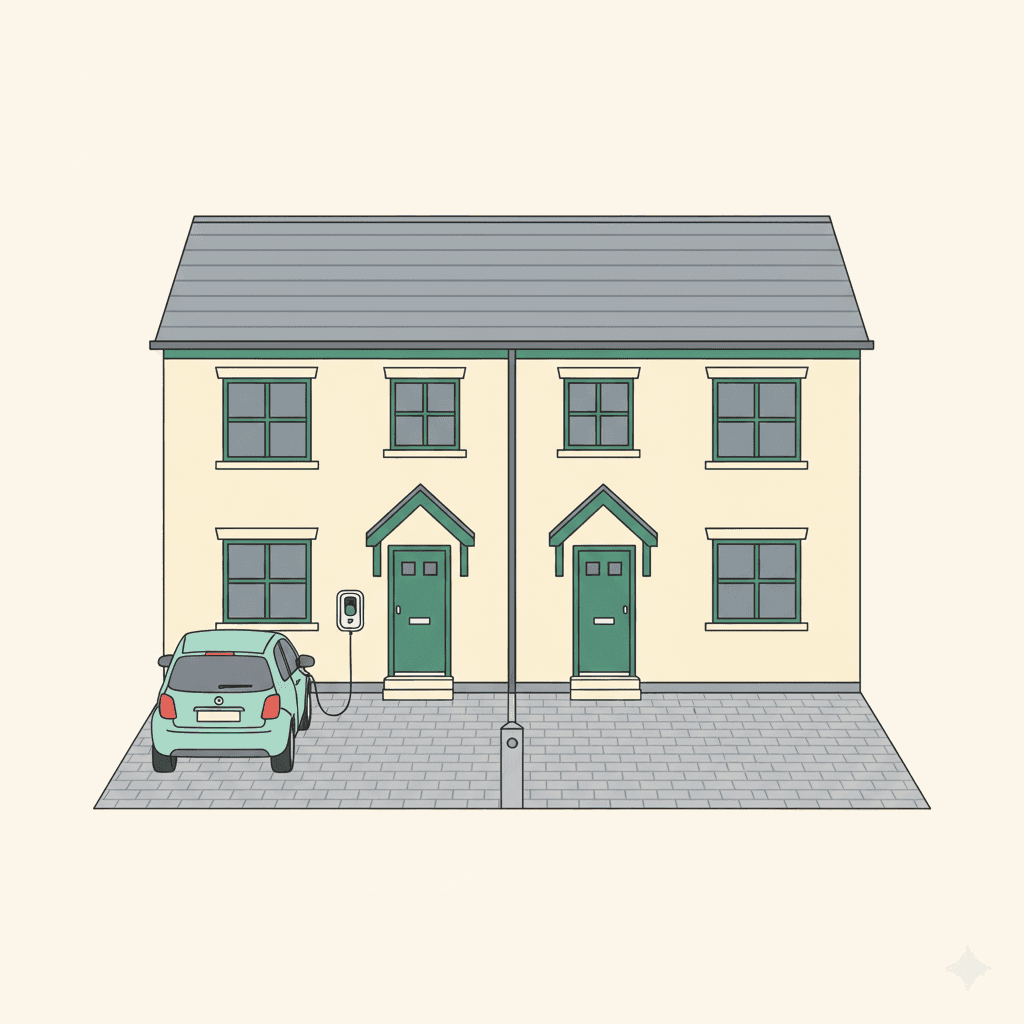
Step 1: Establish who actually owns the driveway
Before contacting an installer, you must determine the precise legal configuration of your driveway. Many homeowners operate on handshake understandings that do not reflect the registered reality at HM Land Registry (HMLR). There are three common ownership configurations in the UK.
How to verify
Do not rely on your memory of the buying process. You must consult:
- The Land Registry Title Plan: Available via the gov.uk property information service, this shows the general boundaries.
- The Title Register: This lists the easements and covenants affecting the land.
- The Original Conveyance: If the HMLR documents are vague, the original deeds often contain detailed diagrams and specific wording regarding maintenance and access.
What the OZEV grant says about shared access
The OZEV Homeowner Chargepoint Grant (the successor to the EVHS) provides up to £500 (from April 2026) towards the cost of a charger for eligible residents. A primary requirement is that the property must have “off-street parking.”
Where parking is shared, OZEV requires the applicant to have “legal entitlement” to the parking space. The installer verifies that the installation is off-street, but they are not legal experts. OZEV's official guidance explicitly states that the government will not intervene in shared access or boundary disputes. It is the homeowner's responsibility to secure all necessary permissions before the installer arrives. If an installation is later found to be in breach of property rights, the grant may be reclaimed.
Full grant eligibility details
See our OZEV grant guide for a complete breakdown of eligibility criteria, how to apply, and what the grant covers.
The cable route: four realistic scenarios
The physical path the cable takes from your consumer unit to the charger determines the level of legal documentation required.
Legal instruments you should know about
To ensure your installation is future-proofed for when you eventually sell your home, you must consider the following legislation.
Cost breakdown
Installing on a shared driveway is invariably more expensive than a standard back-to-back installation.
| Item | Estimated cost (2026) |
|---|---|
| Standard domestic installation | £700 – £1,200 |
| Extended cable run (across shared ground) | +£200 – £500 |
| Deed of Easement (solicitor fees) | £300 – £600 |
| Shared charger (total for 2 properties) | £900 – £1,600 |
| DNO supply upgrade (if required) | £1,000 – £3,000+ |
Surface type significantly affects price: trenching through block paving or concrete and reinstating it to a professional standard is more labour-intensive than cutting through gravel or lawn. The OZEV grant covers up to £500 (from April 2026) per installation, which can be applied to these costs if all eligibility criteria are met.
What to agree with your neighbour
Even if you choose not to use a solicitor for a formal deed, you should draft a Memorandum of Understanding signed by both parties. This should include:
- Ownership: State clearly who paid for the hardware.
- Liability: Who pays the insurance excess if the unit is damaged?
- Access: Does the owner of the charger have a right to enter the neighbour's land for repairs?
- Termination: What happens if the neighbour wants to build a porch where the cable runs?
- Succession: A statement that both parties intend for this agreement to be disclosed to future buyers.
Without these points in writing, a simple falling-out between neighbours could result in permission being rescinded — with no easy legal remedy if the agreement was never properly documented.
Finding the right installer
Not all EV installers are equipped for the complexities of shared access. Some high-volume companies prefer straightforward installations and may cancel your job once they see a shared driveway. When vetting a professional, ask:
- "Have you performed installations involving Deeds of Easement or shared access before?"
- "Will you conduct a physical site survey to identify the cable route across the shared boundary?"
- "Are you OZEV-approved for both the homeowner and multi-unit grant schemes?"
Choosing an experienced installer is particularly vital for Victorian terrace installations, where space is at a premium and boundaries are often blurred. For those in major urban areas, searching for a specialist EV charger installer in London or Birmingham will yield professionals used to these dense configurations.
Get a free quote from an installer experienced with shared driveways
Not all EV installers take on shared access jobs — those who do will survey the cable route across the boundary, advise on what documentation protects you legally, and handle load management if you and your neighbour want to charge at the same time. Enter your postcode to find one near you.
Free · No obligation · All installers OZEV-approved
Permission letter template
Use this as a Letter of Intent — a professional, non-confrontational way to document the arrangement before any work begins. Written consent is required by your installer to submit the OZEV grant claim.
Important: This letter is a starting point, not a registered legal instrument. If the cable route permanently crosses land you do not own in its entirety, you should follow up with a Deed of Easement through a solicitor (typically £300–£600) to protect your property value when you sell.
[Your Name]
[Your Address]
[Your Phone / Email]
[Neighbour's Name]
[Neighbour's Address]
[Date]
RE: Proposed EV Chargepoint Installation at [Your Address] — Shared Driveway Access
Dear [Neighbour's Name],
I am writing to advise you of my intention to install an electric vehicle (EV) chargepoint at my property. As we share a driveway, I want to inform you of the proposal and confirm the arrangements in writing before any work begins.
The Installation
I intend to install a [charger brand and model, e.g. Ohme ePod 7.4kW]. The proposed cable route is: [describe route — e.g. “a shallow conduit running along the shared boundary line from my consumer unit to the parking area”]. A plan showing the exact route is attached for reference.
My Commitments to You
- Access: The installation will not obstruct your right of access at any time, during or after the works.
- Reinstatement: Any disturbed surface — including block paving, tarmac, or landscaping — will be reinstated to its original condition at my expense.
- Maintenance: I will remain solely responsible for the upkeep and safety of the charger and all associated cabling.
- Compliance: All work will be carried out by an OZEV-approved installer in accordance with BS 7671 (IET Wiring Regulations) and the relevant Building Regulations.
I am happy to walk the proposed route with you before any work is instructed. Please do not hesitate to contact me if you have any questions.
Yours sincerely,
Signed: __________________________
[Your Name] Date: ______________
Neighbour's Consent
I, [Neighbour's Name], of [Neighbour's Address], consent to the installation of an EV chargepoint and associated cabling at the above property as described. I confirm that the proposed route does not unreasonably interfere with my use of the shared driveway.
Signed: __________________________
Date: ______________
Before you hand it over
Bring the title plan you downloaded from the Land Registry property information service. Being able to point to the exact boundary line — and show precisely where the cable will run relative to it — removes the ambiguity that most disputes are actually about.
Ownership sorted — now find an installer who won't back out
Once access is agreed and documented, you need an installer who has done this before and won't cancel when they see a shared boundary. Get a free quote from OZEV-approved installers near you — no cold calls, no middlemen.
Free · No obligation · All installers OZEV-approved
Frequently asked questions
Do I need my neighbour's permission to install an EV charger on a shared driveway?
If any part of the cable, the charger unit, or the ground you need to dig up is on land the neighbour owns or shares an interest in, you must have their written consent. If you own the freehold of your side, you generally do not need permission to mount a charger on your own wall, provided the installation does not physically obstruct their right of way.
Can my neighbour block my EV charger installation on a shared driveway?
Yes. If the installation requires access to their land or a shared area where you do not have an existing easement for utilities, they can refuse permission. As of early 2026, there is no 'Right to Charge' legislation in the UK that overrides private property rights. Mediation is recommended over legal threats in these instances.
What happens to the shared charger agreement when I sell my house?
If the agreement is informal (a letter or verbal), it may not bind the new owner. They could legally demand the removal of any cabling on their land. Only a Deed of Easement registered with the Land Registry ensures the right to maintain the charger carries over to the next homeowner.
Can two neighbours share one EV charger to save money?
This is a highly effective way to reduce costs. By installing a single dual-socket unit or using two units with load-balancing technology, you can share the installation and hardware costs. Ensure you have a written agreement regarding electricity billing and what happens if one party moves.
Further reading
- EV charger installation in a Victorian terrace
- EV charger in a leasehold flat: your legal rights
- OZEV grant guide: what you can claim in 2026
- EV charger installation cost UK (2026)
- Party Wall etc. Act 1996 — legislation.gov.uk
- Official OZEV chargepoint grants guidance on gov.uk
- OZEV-approved EV charger installers in London
- OZEV-approved EV charger installers in Manchester
Last updated: February 2026. This guide provides general information, not legal advice. Property law is complex and fact-specific — always read your title documents and seek independent legal advice if in doubt. Grant details are correct as of publication but can change; verify at gov.uk.